
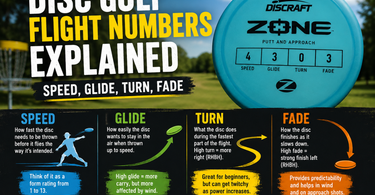
Disc golf flight numbers are supposed to help you understand how a disc flies. The problem is that a lot of players read them too literally.
A disc with flight numbers of 13 | 5 | -1 | 3 does not automatically fly with high speed, big glide, slight turn, and dependable fade for every player. It only flies that way when it is thrown with enough speed, clean enough form, and the right release angle.
That is where a lot of confusion starts.
Flight numbers are useful, but they are not perfect. They are a guide, not a guarantee. Your arm speed, form, release angle, wind, plastic, disc wear, and even the brand all affect how a disc actually flies.
This guide will break down what disc golf flight numbers mean, how to use them correctly, and how to avoid the most common mistake newer players make when buying discs.
What Are Disc Golf Flight Numbers?
Disc golf flight numbers are the four numbers printed on most discs to describe the intended flight.
They are listed in this order:
Speed | Glide | Turn | Fade
For example, a disc with flight numbers of:
9 | 5 | -2 | 1
would be described as a speed 9 disc with good glide, noticeable high-speed turn, and a gentle finishing fade.
Each number tells you something different, but they only make sense when the disc is thrown at the speed it was designed for.
Speed: How Fast the Disc Needs to Be Thrown
Speed is the first flight number, and it is the most misunderstood.
Most players think speed means how far the disc will go. That is not really true.
Speed tells you how fast the disc needs to be thrown before it flies the way the rest of the numbers suggest.
I tell people in the shop all the time, "A higher speed disc has more distance potential. Potential, because most of us can't actually throw it correctly to realize that."
A speed 13 driver is not automatically further flying than a speed 9 driver. A speed 13 driver simply needs more speed and cleaner form to fly correctly. If you cannot throw it fast enough, the disc will usually act more overstable than the numbers suggest.
Nick likes to describe disc speed as a form rating from 1 to 13.
If your form is not a 13, that Innova Boss is probably not going to show the -1 turn printed on the flight chart. It may just fly straight for a moment, dump left early for a right-hand backhand throw, and finish shorter than a slower disc you can actually get up to speed.
That is why many newer players throw fairway drivers farther than distance drivers. A slower disc thrown correctly will often fly better than a faster disc thrown below its intended speed.
Speed and Rim Width
Speed is closely related to rim width. Faster discs usually have wider rims. Wider rims can create more distance potential, but they also demand more from the thrower.
A wide-rimmed distance driver can produce huge flights when thrown correctly, but it also magnifies mistakes. Nose angle issues, early releases, off-axis torque, and slight misreleases become more obvious with faster discs.
The higher speed a disc is, the more lateral movement it can have when thrown. That movement can be useful for big distance lines, but it also makes the disc less forgiving. If your release is off by a little, a high-speed driver may punish you more than a slower fairway or midrange.
That is why slower discs are usually better for learning proper form.
Glide: How Easily the Disc Stays in the Air
Glide is the second flight number. It tells you how much the disc wants to stay in the air when thrown correctly.
A high-glide disc carries longer and stays aloft more easily. This can help newer players get more distance, especially if they are not throwing with a lot of speed and proper nose angle yet.
High-glide discs are great for:
- Easy distance
- Long straight shots
- Turnovers
- Tailwind drives
- Beginner-friendly flights
- Touch shots that need carry
But glide is not always good.
High-glide discs are usually more affected by wind. They can also be harder to range because they want to keep floating. If you are trying to land an approach shot next to the basket, too much glide can be a problem.
Low-glide discs are easier to range. They do not carry as far past the target, and they are often better in wind. This is why low-glide approach discs, like the Kastaplast Berg, are so popular for controlled upshots. They help you throw with confidence without worrying as much about sailing long.
Simple way to think about it:
High glide helps you get distance.
Low glide helps you control distance.
Turn: What the Disc Does at High Speed
Turn is the third flight number. It describes what the disc wants to do during the fastest part of the flight.
For a right-hand backhand throw, a disc with more negative turn will want to move to the right early in the flight. For a left-hand backhand throw, it will move left.
Turn is usually written as a negative number, such as:
0
-1
-2
-3
-4
A disc with 0 turn is more resistant to turning over. A disc with -3 turn is much easier to flip, drift, or turn.
High-turn discs are often great for beginners because they help create easier distance. They usually have more glide, require less power to get moving, and can produce straighter flights for players who do not yet throw fast enough to throw more stable discs.
That is why understable fairway drivers and distance drivers are so popular for newer players.
But there is a tradeoff.
As your arm speed and form improve, high-turn discs can become twitchy. The same disc that once flew straight may start turning too much, drifting off line, or becoming hard to control.
That does not make understable discs bad. It just means their role changes.
For newer players, they can be primary distance drivers.
For advanced players, they become hyzer-flip discs, turnover discs, roller discs, and tailwind drivers.
Fade: How the Disc Finishes
Fade is the fourth flight number. It describes how hard the disc finishes at the end of the flight as it slows down.
For a right-hand backhand throw, fade is the disc’s tendency to finish left. For a left-hand backhand throw, it finishes right.
A disc with 0 or 1 fade will usually finish softly. A disc with 3, 4, or 5 fade will finish much harder.
Fade is useful because it creates predictability. When you throw an overstable disc with reliable fade, you can trust it to fight out of the angle and finish in a specific direction.
High-fade discs are useful for:
- Headwinds
- Forehands
- Hyzers
- Flex shots
- Skip shots
- Approach shots that must finish
- Utility lines
The downside is that too much fade can cost distance and control for newer players. If a disc fades before it has a chance to fly forward, it will usually dump out early and land short.
That is why a beginner throwing a very overstable driver may feel like every disc “just goes left.” The disc is not broken. It is simply not getting enough speed to fly the way it was designed.
Why Flight Numbers Do Not Always Match Between Brands
One of the biggest mistakes players make is comparing flight numbers across brands as if they are perfectly standardized.
They are not.
A 7 | 5 | -1 | 1 from one company may not fly exactly like a 7 | 5 | -1 | 1 from another company.
In general, some brands tend to fly more overstable than their numbers suggest, while others often feel less stable than the numbers imply.
As a broad rule of thumb:
MVP, Axiom, Streamline, and Innova often fly more overstable than newer players expect.
Kastaplast, Latitude 64, and Westside Discs often feel less stable or more workable than the numbers suggest.
That does not mean the numbers are wrong. It means each company has its own rating tendencies, plastic blends, and mold design philosophy.
This is also why customer reviews, in-hand experience, and brand familiarity matter. Once you learn how a company’s numbers usually translate for your arm speed, flight numbers become much more useful.
Somehting to remember, flight Numbers typically make sense within the specific manufacturers lineup. Example: An Innova Champion Roadrunner has flight numbers of 9,5,-4,1. This suggest the Roadrunner is extremely understable but in my experience, that's not the case and it is much more neutral flying. When compared to the rest of the Innova 9 speed lineup the flight numbers fit.
Plastic Can Change Flight
The same mold can fly differently in different plastics.
A premium plastic version may be more stable and hold its original flight longer. A baseline plastic version may beat in faster, gain turn, and become easier to shape. Glow plastic, lightweight plastic, and specialty blends can also change how a disc feels and flies.
For example, a disc in durable premium plastic may resist turn longer than the same mold in a softer or lighter blend. A lightweight version may be easier for slower arms to get up to speed. A baseline putter may season into straighter flights faster than a premium throwing version.
This is why plastic-specific product pages matter. “Discraft Zone” is the mold. “Z Zone,” “Jawbreaker Zone,” and “ESP Zone” are not identical buying decisions. The mold gives you the general flight identity, but the plastic helps decide feel, grip, durability, and how quickly the disc changes over time.
Weight Also Matters
Disc weight can change how easy it is to get a disc flying correctly.
Lighter discs are generally easier to get up to speed. They can help newer players access more glide, more turn, and more distance. They can also be useful for tailwinds or players who want effortless carry.
Heavier discs are often more stable, more wind-resistant, and more predictable under power. They can be better for experienced players, forehands, headwinds, and controlled placement shots.
A 150-class distance driver and a max-weight version of the same mold may not fly the same for you.
Wear Changes Flight Over Time
Discs do not stay exactly the same forever.
As a disc beats in, it usually becomes less stable. It may start turning more, fading less, and holding straighter or more understable lines.
This is especially noticeable with baseline plastics, but premium plastics change too. They just change more slowly.
This is why experienced players sometimes cycle the same mold. They may carry one fresh version for stability, one seasoned version for straight shots, and one beat-in version for turnovers.
Best Flight Numbers for Beginners
Most beginners should not start with fast, overstable distance drivers.
The best beginner discs are usually slower, glidey, and somewhat understable. They are easier to throw correctly and give better feedback on your form.
Good beginner ranges:
Putters: 2-3 speed, neutral turn and fade
Midranges: 4-5 speed, good glide, straight to slightly understable
Fairway drivers: 6-8 speed, glidey, neutral to understable
Distance drivers: Usually wait, or choose understable options if you are ready
For a newer player, a fairway driver with numbers like 7 | 5 | -2 | 1 (like the Innova Champion Leopard3) may fly farther and straighter than a high-speed driver with numbers like 13 | 5 | -1 | 3 (like the Innova Star Boss).
That is because the slower disc is easier to get up to speed.
Remember the form rating idea. If your current form is a 7, a speed 7 driver may show you a true flight. A speed 13 driver probably will not.
Best Flight Numbers for Distance
If you want more distance, do not automatically grab the fastest disc.
Instead, look for the fastest disc you can actually throw correctly.
For many players, max distance comes from a disc that has:
- Enough speed to create distance potential
- Enough glide to carry
- Enough turn to get a full flight
- Enough fade to finish without burning over
That usually means a disc with some turn, not a meathook.
For slower arms, understable fairway drivers and understable 9-10 speed drivers can be excellent distance options. For advanced arms, higher-speed drivers with moderate turn and reliable fade can produce bigger S-curves and long pushing flights.
The key is matching the disc to your power.
Best Flight Numbers for Control
If you want control, slower is usually better.
Midranges, putters, and fairway drivers are easier to range than high-speed distance drivers. They have smaller rims, less lateral movement, and less punishment on slight misreleases.
For controlled shots, look for:
- Lower speed
- Moderate to low glide if distance control matters
- Neutral turn
- Predictable fade
This is why overstable approach discs are so popular. They may not go far, but they are easy to predict. When the goal is landing near the basket, predictability matters more than raw distance.
Turn vs Fade: The Simple Explanation
Turn happens early when the disc is moving fast.
Fade happens late when the disc slows down.
A disc with high turn and low fade will be easier to flip and may finish softly.
A disc with low turn and high fade will resist flipping and finish harder.
A disc with both turn and fade can create an S-shaped flight. It turns early, glides forward, then fades back at the end.
A disc with no turn and heavy fade is usually overstable.
A disc with lots of turn and little fade is usually understable.
Why Your Disc Does Not Fly Like the Numbers
If your disc does not fly like the numbers suggest, one of these things is probably happening:
You are not throwing it fast enough.
Your nose angle is too high.
The disc is too overstable for your current form.
The plastic or weight is making it more stable.
The disc is new and has not beaten in.
You are throwing in wind.
Your release angle does not match the shot you are trying to throw.
Flight numbers are not magic. They are a starting point for understanding what the disc is trying to do.
How to Actually Use Flight Numbers When Buying Discs
The best way to use flight numbers is to compare discs within the same category.
Do not compare a speed 13 driver directly to a speed 5 midrange and assume the higher-speed disc is better. Compare putters to putters, mids to mids, fairways to fairways, and distance drivers to distance drivers.
Then ask:
Can I throw this speed correctly?
Do I need more glide or more distance control?
Do I want the disc to turn?
Do I need a reliable fade?
Am I buying this for power, touch, wind, woods, forehands, or open distance?
That is how flight numbers become useful.
FAQ
What do disc golf flight numbers mean?
Disc golf flight numbers describe a disc’s intended flight using four ratings: speed, glide, turn, and fade. Speed tells you how fast the disc needs to be thrown, glide describes how well it stays in the air, turn describes early high-speed movement, and fade describes the finish at the end of the flight.
Are disc golf flight numbers accurate?
Flight numbers are useful, but they are not perfect. They are a guide, not a guarantee. Arm speed, form, release angle, plastic, weight, wear, wind, and brand rating tendencies all affect how a disc actually flies.
What flight numbers are best for beginners?
Most beginners should look for slower discs with glide and some understability. Good starting points are neutral putters, straight midranges, and fairway drivers in the 6-8 speed range with some turn and a gentle fade.
What does speed mean in disc golf?
Speed tells you how fast a disc needs to be thrown before it flies the way it is intended. It does not automatically mean the disc will go farther. If you cannot throw a disc up to speed, the rest of the flight numbers will not fully show up.
What does glide mean in disc golf?
Glide describes how easily a disc stays in the air. High-glide discs can carry farther and help newer players get more distance, but they can also be more affected by wind and harder to range on approach shots.
What does turn mean in disc golf?
Turn describes what the disc does during the fastest part of the flight. A more negative turn number means the disc is easier to flip, drift, or turn. For a right-hand backhand throw, turn usually means the disc moves right early in the flight.
What does fade mean in disc golf?
Fade describes how strongly the disc finishes as it slows down. Higher fade means a harder finish. For a right-hand backhand throw, fade usually means the disc finishes left at the end of the flight.
Why does my distance driver fade left immediately?
Your distance driver is probably not getting up to speed. Fast drivers need more power and cleaner form to show their intended turn and glide. If a disc is thrown too slowly or with the nose up, it will often fade early and fly shorter than expected.
Is a higher-speed disc better?
Not always. A higher-speed disc only helps if you can throw it fast enough. Many players get more distance and control from slower fairway drivers because those discs are easier to get up to speed and fly correctly.
Turn vs Fade
For a right handed player throwing backhand, turn is the initial high speed movement of the disc to the right whereas fade is the movement back to the left when the disc slows down.
Final Thoughts: Flight Numbers Are a Tool, Not the Truth
Disc golf flight numbers are helpful, but they are not absolute. They give you a language for understanding discs, but they do not replace real-world flight, arm speed, plastic feel, weight, wear, and conditions.
The biggest lesson is simple:
Do not buy the fastest disc. Buy the disc you can throw correctly.
Once you understand speed, glide, turn, and fade, you can make better choices, build a smarter bag, and stop fighting discs that were never matched to your game in the first place.
A slower disc that flies correctly will almost always beat a faster disc that never gets up to speed.